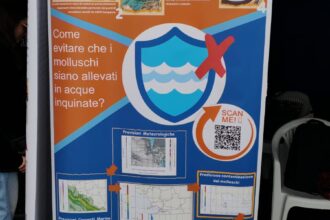
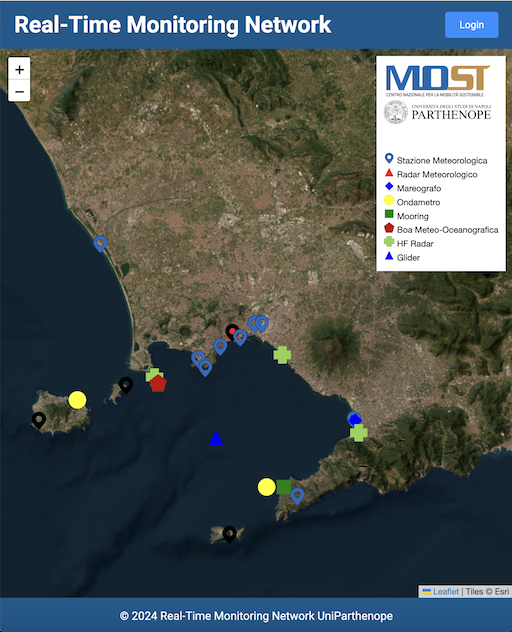
The High-Performance Scientiic Computing Laboratory (https://hpsclab.uniparthenope.it, Department of Science and Technology, University of Naples “Parthenope”) is involved in an ongoing series of research projects funded by the Veterinary sector of the Campania Region with the final aim of the prediction of the bacterial contamination in farmend mussels leveraging an HPC+AI computational workflow.
Since the begin of this challanging research in 2009 when a pilot research project focused on delivering forecasts about intert transport and diffusion on the bay of naples, the HPSC Laboratory research group lead by Raffaele Montella achieved resutls in both scientific and technological products.
The MytiluSE project (Modelling mytilus farming System with Enhanced web technologies, 2016) had the ambition of extending the computational domain to the whole Campania region covering part of the southern Lazio and northen Calabria with a ground resolution of about 200 meters. During this project the BlackJeans HPC machine has been extended to support the project and its related components.
The MytilAI project (Modelling mytilus farming with Artificial Intelligence technologies, 2021) filled the gap between the bacterial-like concentrations in seawater forecasting to the bacterial mussels contamination leveraging Artificial Intellgence tecniques using a novel integration between HPC numerical models and multiple AI models trained with periodic microbiological analysis provided by the local health organization.
Since 2023, thanks to the MytilEx project (extended Modellig mytilus farming System with High Performance Computing and Artificial Intelligence) the bacterial contamination in farmed mussels prediction system is used routinely by. the local health organization in order to prevent and manage contamination events provinding a web application used by the field experts.
Although this success story results, a crucial queston arose about the fact that the High-Performance Computing + Artificial Intelligence methodology for mussels bacterial contamination developend and used in production in the Campania region is actually scalable.
To answer this research question the MytilX project (Modelling mytilus farming at scale) has been funded by the Istituto Zooprofilattico Spermentale di Umbria e Marche within a cooperation framework with the CEREM, the center for microbiological and chemical control of the bivalves mussels livestocks.
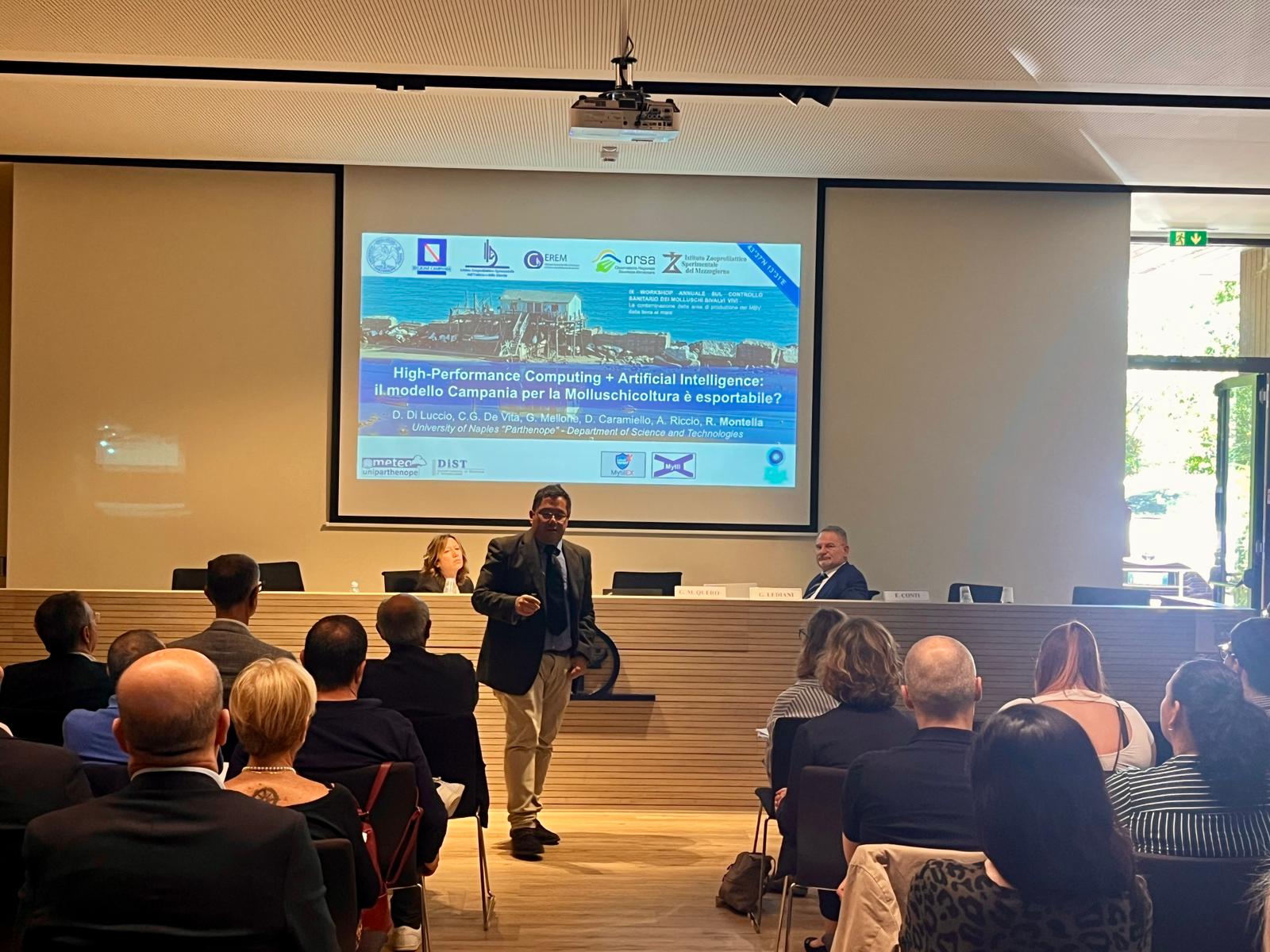
Within the framework of the MytilX research project, Raffaele Montella has been invited to have a talk with the tile “High-Performance Computing + Artificial Intelligence: is the Campania methodology for mussels bacterial contamination scalable?” at the “IX WORKSHOP ANNUALE SUL CONTROLLO SANITARIO DEI MOLLUSCHI BIVALVI VIVI – La contaminazione delle aree di produzione dei MBV: dalla terra al mare”.
The talk has been focused on the presentation of the system already working in the Campania region and the encouraging preliminary results on the Marche region alongside the future research directions.
Raffaele Montella is an Associate Professor with tenure in Computer Science at the Department of Science and Technologies (DiST), University of Naples “Parthenope'” (UNP), Italy. He got his degree (MSc equivalent) cum laude and an award mention to his study career in (Marine) Environmental Science at the University of Naples “Parthenope” in 1998, defending a thesis about the “Development of a GIS system for marine applications”.
He defended his Ph.D. thesis on “Environmental modeling and Grid Computing techniques” earning a Ph.D. in Marine Science and Engineering at the University of Naples “Federico II”.
His main research topics and scientific production are focused on: tools for high-performance computing, cloud computing, and GPUs with applications in the field of computational environmental science (multi-dimensional geo-referenced big data, distributed computing for modeling, and scientific workflows and science gateways) leveraging on his previous (and still ongoing) experiences in embedded, mobile, wearable, pervasive computing, and Internet of Things.
He joined the CI/RDCEP of the University of Chicago as Visiting Scholar and Visiting Assistant Professor working on the FACE-IT project.
He leads the High-Performance Scientific Computing (HPSC) Laboratory and the IT infrastructure of the UNP Center for Marine and Atmosphere Monitoring and Modeling (CMMMA).
He technically led the University of Naples “Parthenope” research unit of the European Project “Heterogeneous secure multi-level Remote Acceleration service for low-Power Integrated systems and Devices (RAPID)”. His effort focused on GVirtuS development and integration (General purpose Virtualization Service), enabling CUDA kernel execution on mobile and embedded devices.
He led the locally funded project: “Modeling mytilus farming System with Enhanced web technologies (MytiluSE)” focused on high-performance computing based coupled simulations for mussels’ farms’ food quality prediction and assessment for human gastric disease mitigation.
He leads the locally funded project “MytilAI – Modeling mytilus farming with Artificial Intelligence technologies”, focused on using AI techniques for mussel pollutants contamination predictions.
He leads the research project: “DYNAMO: Distributed leisure Yacht-carried sensor-Network for Atmosphere and Marine data crOwd-sourcing applications”, targeting coastal marine data gathering as crowd-sourcing for environmental protection, development, and management.
He led the UNP unit of the Erasmus+ Project “Framework for Gamified Programming Education (FGPE)” and is leading the UNP unit of the project “FGPE Plus: Learning tools interoperability for gamified programming education” as an ideal extension of FGPE ending in May 2021.
Since 2021 he has been head of the UNP node CINI Lab/Working Group “HPC: Key Technologies and Tools”. Since 2022 he has been the head of the AWS Academy at the University of Naples “Parthenope”.
In February 2023, he gained the Italian National Academic Qualifications as Full Professor in Computer Science (01/B1).