The University of Naples “Parthenope” runs a Center for Monitoring and Modeling Marine and Atmosphere research and applications (CMMMA) known as “meteo@uniparthenope” delivering daily updated high-resolution weather, ocean, and pollution forecasts. The center has been officially active since 2011, offering weather services for major events such as the America’s Cup World Series in 2012 and 2013, as well as the Universiade in 2019. The meteo@uniparthenope services are freely available through its web application https://meteo-dev.uniparthenope.it, while the customized applications for local institutions are available as external services.
The High-Performance Scientific Computing Laboratory (HPSC Lab, https://hpsclab.uniparthenope.it) of the Department of Science and Technology of the University of Naples “Parthenope” is in charge of the design, implementation, and management of the computational scientific workflow producing the forecast data in a routine fashion and the related High-Performance Computing dedicated infrastructure, including the instrument network design, implementation, and management.
The HPSC Lab was established in 2007 following the previous lineage of the academic tradition in multidisciplinary applications of mathematics and computer science. The HPSC Lab undertakes a twofold mission: developing multidisciplinary computational and mathematical sciences investigations using cutting-edge analytical approaches, numerical methods, scientific computing tools, innovative data analysis algorithms, and advanced, low-cost, high-performance computing platforms; and enabling distributed, collaborative, and virtual environments by developing system software key technologies and tools.
Data path
Except where specified otherwise, data is organized hierarchically following the following schema:
product/domain/archive|history/yyyy/mm/dd/product_domain_yyyymmddZhhmm.nc
Where:
- Product: 4-character code of the product as follows:
- wrf5 Weather Research and Forecasting – Weather Forecast
- ww33 Wavewatch III – Waves driven by wind
- rms3 Regional Ocean Model System – Coastal dynamics
- wcm3 WaComM++ – Inert transport and diffusion
- aiq3 Aiquam++ – Artificial Intelligence water quality model
- Domain, three digits:
- d01 Coarse domani, European region
- d02 Medium domain, the Italian peninsula, and surrounding seas
- d03 South of Italy centered on the Campania Region
- yyyy: Year, 4 digits
- mm: Month, two digits (01, January; 12, December)
- dd: Day of the month (01, 31)
- hh: Hour of the day (24 hours, 00, 23)
- mm: Minutes of the hour, usually 00
Data is available using an Application Programming Interface, OPEnDAP Server, HTTP, and Signal K.
Application Programming Interface, https://api.meteo.uniparthenope.it
The HTTP APIs are freely accessible with no technical restrictions. At the time of writing this note, no key registration is needed. The APIs can be invoked without authentication.
Metadata about APIs is available at the Swagger URL: https://api.meteo.uniparthenope.it/swagger.json
OpennDAP, https://data.meteo.uniparthenope.it/opendap/
OPeNDAP (Open-source Project for a Network Data Access Protocol) is an endeavor focused on enhancing the retrieval of remote, structured data through a Web-based architecture and a discipline-neutral Data Access Protocol (DAP). The OPEnDAP protocol is widely used in Earth science. It is layered on HTTP, and it is intended to enable remote, selective data retrieval as an easily invoked Web service. Many open-source and commercial data analysis software can ingest data from OPEnDAP servers.
HTTP, https://data.meteo.uniparthenope.it/files/
Data produced by models can be downloaded using HTTP via a regular browser or utilities like curl (https://curl.se/) and wget (https://www.gnu.org/software/wget/).
- Curl is a command-line tool for transferring data specified with URL syntax.
- GNU Wget is a free software package for retrieving files using HTTP, HTTPS, FTP, and FTPS, the most widely used Internet protocols. It is a non-interactive command-line tool, so it may easily be called from scripts, cron jobs, terminals without X-Windows support, etc.
The HTTP data provisioning is suggested for routine data downloads.
Grib, https://data.meteo.uniparthenope.it/grib/
GRIB (GRIdded Binary or General Regularly-distributed Information in Binary form) is a concise data format commonly used in meteorology to store historical and forecast weather data. Grib data is updated multiple times per day, each time a model completes its full or partial run.
Data is organized as follows:
- Meteo_uniparthenope_d01.grb
Weather and marine forecast for 72 hours in the European region. - Meteo_uniparthenope_d02.grb
Weather and marine forecast for 48 hours in the Italian peninsula and surrounding seas - Meteo_uniparthenope_d03.grb
Weather and marine forecast for 48 hours in southern Italy, centered on the Campania region.
Data are also available in compressed formats, such as zip and gzip.
Signal K, https://signalk.meteo.uniparthenope.it
Signal K is a data standard, a local hub, and an ecosystem of plugins & web apps for collecting and sharing boat data, defining an open marine platform (https://signalk.org).
meteo@uniparthenope provides live data from AIS (Bay of Naples) and weather stations as a Signal K meteo context.
AIS Data are available for download as open data: https://data.meteo.uniparthenope.it/instruments/aisnet0/
Weather Data can’t be downloaded, but compatible marine electronics multi-functional displays can connect to the Signal K server and display live weather data directly on marine charts.
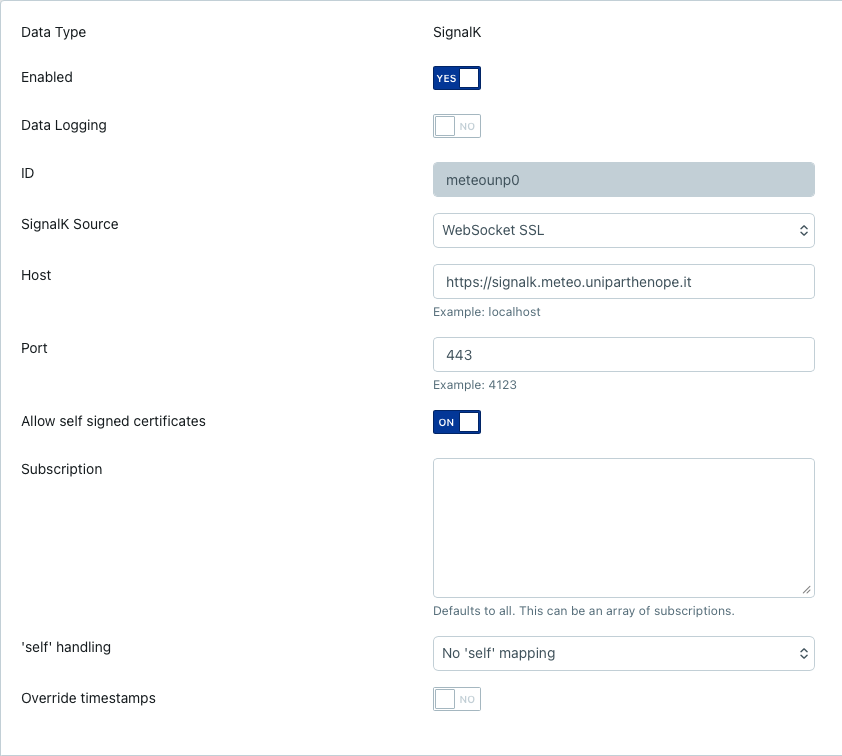
To receive Signal K data from meteo@uniparthenope, set your on board Signal K server data connection as shown in the picture.
Disclaimer
Data and derived maps are generated automatically using numerical weather prediction techniques with no human intervention. Products are provided as is. The interpretation must be performed by experts at their own risk. All the published information is, in any case, in substitution for official documents. UTC references all time. In any case, the meteo@uniparthenope staff, the CMMMA, the Department of Science and Technologies, the University of Napoli Parthenope, and any person involved in related research and production activities are responsible for damages and injuries to goods and people.
License
All data are published as open data under the Italian Open Data License v2.0.