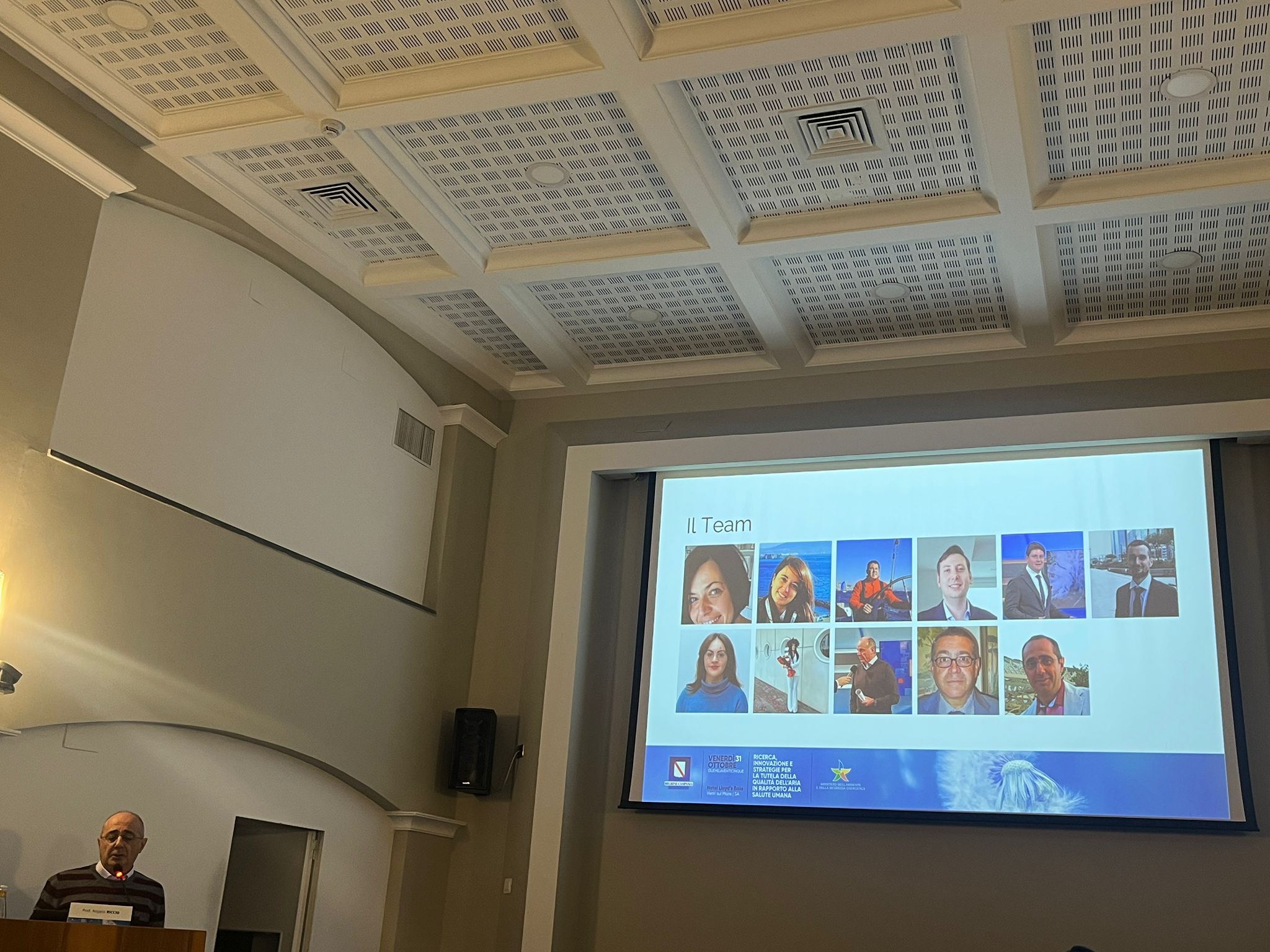
On October 31, at the Lloyd’s Baia Hotel in Vietri sul Mare, a conference organized by the Campania Region was held on the theme “Research, Innovation and Strategies for the Protection of Air Quality in Relation to Human Health.”The event marked the closing session of the Program Agreement between the Campania Region and the Ministry of the Environment and Energy Security (MASE), launched in 2021 to improve air quality. The conference featured representatives from MASE, institutions of the Campania Region, and ARPAC (Regional Agency for Environmental Protection), along with a large group of young researchers.
Professor Angelo Riccio, Associate Professor in the field of Physics for the Earth System, Planets, Space, and Climate, took part in the event as Principal Investigator of the SCINTILLA project (Innovative Tools and Technologies for the Protection of Air Quality and Human Health). Thanks to the collaboration with experts in machine learning and high-performance numerical computing from the HPSC SmartLab (High-Performance Scientific Computing Smart Laboratory), together with oceanographers, meteorologists, and environmental chemists from the Department of Science and Technology and researchers from the Remote Sensing Lab of the Department of Engineering, the project was able to integrate multiple competencies to address such a complex and interdisciplinary topic as strategies for the protection and improvement of air quality.
The discussions highlighted the potential of advanced numerical models for simulating air quality in Campania—integrated with meteorological data and updated emission inventories—the use of machine learning and data fusion techniques with satellite data, and the analysis of the chemical and physical properties of particulate samples collected in the Naples and Avellino areas. The results proved promising for reconstructing the temporal patterns of pollution and analyzing its impacts on health.
The event concluded with an institutional roundtable, aimed at outlining an integrated and shared strategy to improve air quality and prevent negative impacts on public health.
Raffaele Montella is an Associate Professor with tenure in Computer Science at the Department of Science and Technologies (DiST), University of Naples “Parthenope'” (UNP), Italy. He got his degree (MSc equivalent) cum laude and an award mention to his study career in (Marine) Environmental Science at the University of Naples “Parthenope” in 1998, defending a thesis about the “Development of a GIS system for marine applications”.
He defended his Ph.D. thesis on “Environmental modeling and Grid Computing techniques” earning a Ph.D. in Marine Science and Engineering at the University of Naples “Federico II”.
His main research topics and scientific production are focused on: tools for high-performance computing, cloud computing, and GPUs with applications in the field of computational environmental science (multi-dimensional geo-referenced big data, distributed computing for modeling, and scientific workflows and science gateways) leveraging on his previous (and still ongoing) experiences in embedded, mobile, wearable, pervasive computing, and Internet of Things.
He joined the CI/RDCEP of the University of Chicago as Visiting Scholar and Visiting Assistant Professor working on the FACE-IT project.
He leads the High-Performance Scientific Computing (HPSC) Laboratory and the IT infrastructure of the UNP Center for Marine and Atmosphere Monitoring and Modeling (CMMMA).
He technically led the University of Naples “Parthenope” research unit of the European Project “Heterogeneous secure multi-level Remote Acceleration service for low-Power Integrated systems and Devices (RAPID)”. His effort focused on GVirtuS development and integration (General purpose Virtualization Service), enabling CUDA kernel execution on mobile and embedded devices.
He led the locally funded project: “Modeling mytilus farming System with Enhanced web technologies (MytiluSE)” focused on high-performance computing based coupled simulations for mussels’ farms’ food quality prediction and assessment for human gastric disease mitigation.
He leads the locally funded project “MytilAI – Modeling mytilus farming with Artificial Intelligence technologies”, focused on using AI techniques for mussel pollutants contamination predictions.
He leads the research project: “DYNAMO: Distributed leisure Yacht-carried sensor-Network for Atmosphere and Marine data crOwd-sourcing applications”, targeting coastal marine data gathering as crowd-sourcing for environmental protection, development, and management.
He led the UNP unit of the Erasmus+ Project “Framework for Gamified Programming Education (FGPE)” and is leading the UNP unit of the project “FGPE Plus: Learning tools interoperability for gamified programming education” as an ideal extension of FGPE ending in May 2021.
Since 2021 he has been head of the UNP node CINI Lab/Working Group “HPC: Key Technologies and Tools”. Since 2022 he has been the head of the AWS Academy at the University of Naples “Parthenope”.
In February 2023, he gained the Italian National Academic Qualifications as Full Professor in Computer Science (01/B1).